
From AI Assistance to AI Architecture
PREPARING ORGANIZATIONS FOR THE NEXT STAGE OF AI-POWERED TEAMWORK
- ATLASSIAN
| Mané Manukyan | 2026-03-03 | 8 minutes read |

Generative AI has unlocked new levels of productivity across the enterprise. It helps summarize information, draft documentation, generate code, and accelerate knowledge access. Tasks that once required significant manual effort can now be completed in seconds.
These capabilities have significantly improved individual productivity. But most enterprise work is not performed in isolation. It depends on coordination between teams, systems, and shared knowledge.
This is where the next stage of AI begins: agentic AI — where generative intelligence moves from assisting individuals to orchestrating work.
While generative AI enhances individual productivity, agentic AI extends intelligence into operational processes. It observes context, supports decision-making, takes action within defined guardrails, and continuously improves. Rather than responding to prompts alone, it becomes part of how work progresses.
This shift matters because collaboration — not individual output — determines how organizations perform. In large enterprises, teams lose billions of work hours every year due to ineffective coordination and fragmented knowledge. Organizations that adopt AI more broadly are significantly more likely to achieve goal clarity, knowledge accessibility, effectiveness, and adaptability.
Agentic workflows represent the next step in strengthening how teams work together.
To understand why, it helps to look at how AI is taking shape inside the enterprise.
The evolution of AI inside the enterprise
Traditional automation follows predefined rules. It executes static instructions in sequence. When something unexpected occurs, processes slow down.
Agentic AI introduces intelligence into this model. Unlike traditional automation, AI agentic workflows can:
- Make decisions independently
- Understand context across text, systems, and data sources
- Adapt to changing conditions in real time
- Learn from outcomes through feedback loops
These workflows follow a continuous pattern:
PERCEIVE → DECIDE → EXECUTE → LEARN
AI agents collect information across emails, databases, documents, and connected systems. In agentic workflows, AI agents analyze context using machine learning models, select the most appropriate action, execute within defined boundaries, and monitor outcomes to improve future performance.
This form of contextual, workflow-embedded intelligence becomes tangible in Atlassian Rovo.
Rovo is structured around three connected capabilities:
- Find – Enterprise-wide Search across Atlassian Cloud data and connected third-party systems
- Learn – AI-driven insights, knowledge cards, and conversational exploration via Rovo Chat
- Act – Specialized Rovo Agents embedded directly into workflows
This “Find, Learn, Act” framework represents the progression from generative AI to agentic capability. Chat enhances understanding. Agents move work forward.
What makes agentic workflows different
The defining characteristic of agentic AI is intelligence within execution.
Traditional automation executes predefined steps. Agentic workflows evaluate context before acting. They weigh options, consider historical outcomes, and adapt dynamically.
Several components enable this capability:
- AI gathers information from documents, systems, and connected data sources
- Machine learning models help evaluate situations and recommend the best action
- Actions are carried out through APIs and automation that interact with existing software systems
- Feedback loops allow the system to learn from outcomes and improve future decisions
- Security controls and audit trails ensure actions stay within defined permissions
This architecture transforms automation from rigid execution into adaptive collaboration between systems and humans.
Agentic AI in practice: Rovo inside real workflows
Rovo Agents function as configurable AI teammates. They can be invoked in Rovo Chat, embedded in automation rules, accessed directly inside Jira and Confluence, or used within the Studio app. Depending on permissions and connected sources, they can access relevant knowledge across Atlassian and third-party systems.
They are designed to:
- Operate with defined objectives and parameters
- Reduce repetitive effort
- Specialize in particular domains
- Perform structured tasks with user permission

Engineering: From manual triage to intelligent theming
Engineering leaders often spend hours reviewing and grouping Jira issues into themes. The Jira Theme Analyzer Agent reduces this effort from hours to seconds. The Agent analyzes issues, groups them into themes, and can even assign ownership based on contribution history. What was once manual coordination becomes guided collaboration between human and AI.
Developers also benefit from staying in flow. With Rovo integrated into GitHub Copilot, they can access relevant Jira and Confluence knowledge directly within their IDE without switching context. This reduces context switching and helps developers stay focused on their work.
IT Service Management: Intelligent triage and resolution
IT teams face high ticket volumes and limited visibility across systems. The Service Request Helper Agent accelerates incident management by:
- Identifying similar issues for context
- Recommending subject matter experts
- Generating tailored draft responses
- Providing instant summaries of ticket updates
Instead of manually reviewing long ticket histories, agents can ask, “What happened overnight?” and receive an immediate summary. This allows them to respond faster while staying in control of the resolution.
Knowledge discovery and onboarding
Knowledge fragmentation remains one of the largest productivity barriers. Research cited by Atlassian indicates that more than half of knowledge workers struggle to find the information they need — even when they know who to ask.
Rovo Chat helps managers accelerate onboarding by enabling new employees to explore team structures, projects, and cross-functional context directly within their onboarding plans. Faster onboarding translates into faster value creation.

Leadership preparation: the foundation for sustainable AI adoption
The examples above illustrate what agentic AI can do inside workflows. But realizing this potential at scale requires more than technology alone.
Four leadership priorities shape responsible AI adoption:
- Address trust and security concerns
- Understand technical and cultural barriers
- Identify ROI-driven use cases
- Set clear targets and encourage knowledge-sharing
As AI becomes embedded in workflows, governance and cultural readiness naturally become structural requirements.
Trust, governance, and responsible AI
Enterprise AI requires deliberate safeguards, which is why leaders must ensure that AI vendors clearly define how data is handled, avoid using customer inputs and outputs to train models across other customers, and clearly state how data is used. Employees need assurance that their data is protected and responsibly managed.
Security controls, access limits, and audit trails are essential components of agentic workflows.
Leaders must communicate openly, address misconceptions, and involve employees early to build trust. Accountability must scale alongside autonomy.
Cultural readiness and technical integration
AI adoption is as much cultural as it is technical. Common barriers include resistance to change, fear of role disruption, poor data quality, and integration challenges with existing systems. Leaders must champion AI as an augmentation tool that amplifies human capability, not replaces it.
For agentic workflows to deliver value, organizations need reliable data and systems that work together smoothly. As adoption grows, they also need infrastructure that can support scale without sacrificing oversight or control.
In this context, AI must be embedded into the broader system of work, not layered on as an isolated feature.
AI-powered teamwork within the Atlassian System of Work
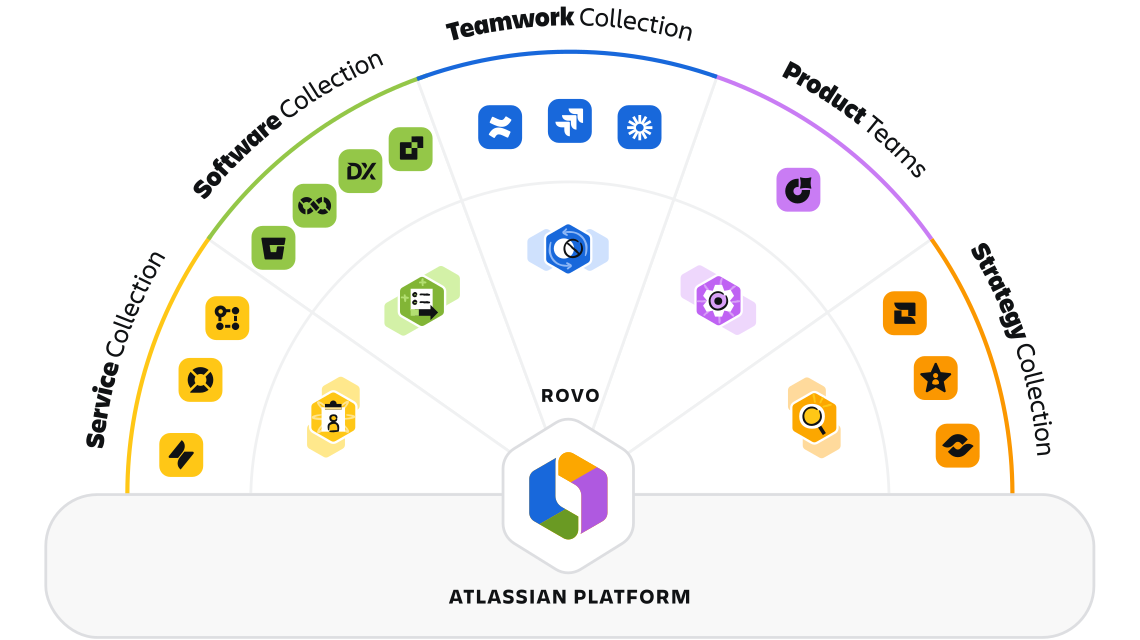
Rovo’s impact is amplified within Atlassian’s broader ecosystem.
Rovo connects enterprise-wide search, AI-powered learning, and specialized agents to unlock organizational knowledge. It supports developers, IT teams, managers, marketing leaders, and sales teams through contextual intelligence embedded directly into daily workflows.
Rather than operating as isolated automation, agentic AI becomes part of a unified collaboration layer—spanning Jira, Confluence, and connected SaaS tools.
The result is AI-powered teamwork: connected knowledge, contextual insights, and meaningful action.
AI-Powered Teamwork as Part of Enterprise Architecture
The progression from generative AI to agentic AI reflects a structural shift.
Agentic workflows:
- Reduce repetitive operational effort
- Improve decision quality through contextual analysis
- Scale without proportional resource growth
- Continuously learn and adapt
- Enhance user and customer experiences
For C-suite and IT leaders, the strategic questions become:
Is governance explicit and enforceable?
Are technical and cultural barriers addressed?
Are high-impact use cases clearly defined?
Is AI embedded within a connected system of work?
Sustainable AI adoption does not happen overnight. It is iterative and deliberate. To scale agentic workflows responsibly, organizations need clear governance and trust boundaries, integrated systems with reliable data, and measurable use cases with defined targets.
When those elements are in place, AI-powered teamwork becomes part of the enterprise architecture — a direction already reflected in Atlassian’s System of Work, where AI capabilities such as Rovo are embedded directly into collaboration and service workflows.
Sources:
If you are considering how AI could fit into your enterprise architecture, ByteSource can help you design a scalable, governance-ready approach.